

A SPECIAL EPISODE FOR LENT AND GOOD FRIDAY: St. Therese of Lisieux and The Holy Face Devotion – Loving the Imperfect
Transcript:
Welcome to Loving the Imperfect. This is a special episode for Lent or Good Friday. We will begin by talking a little bit about St. Therese of Lisieux the 19th century mystic, from the Lisieux convent in France. Afterward I will talk a little bit about what mysticism is because there’s a lot of misconceptions about that.
And then afterward, at the very end of this episode is a holy face meditation that I wrote myself, but I encourage you to add to it using your own imagination and thinking about what Jesus through the senses might have experienced on the cross.
I hope that you enjoy this episode and that it’s fruitful for you and all these episodes will continue to be fruitful for you. As you move forward in your spiritual life.
Thank you for listening.
My name is Brianne Turczynski. Welcome to Loving the Imperfect, I know I said I would go through some modern-day prophets this season, but I’ve been having a very busy 2026 already, so I’m just doing whatever I want with this podcast. Loving the Imperfect is an interspiritual podcast where I just like to share the things that I’ve read or that I’ve found that I think are beautiful and inspiring and life giving. And so, this is a presentation I did for lent for my church, and I thought I should share this with more people.
I wanted to talk to you about St. Theres of Lisieux and her devotion to the Holy Face of Jesus. And then afterward, we’re going to do a meditation on the Holy Face. It is everything that Jesus would’ve maybe experienced on the cross.
So, it’s from his perspective, and we go through all the senses. The purpose of this is that if you have trouble with centering prayer or maybe contemplative prayer, this will kind of get you started. It’s helpful also to open the heart to empathy and to sort of experience maybe what others feel or experience.
So if you came to this video, because you’re looking for that meditation, go toward the end of the video a little bit and you’ll start to hear the meditation, so you can find it that way. And for those of you listening on the podcast, you can go to the end of the podcast and find the meditation there.
Anyway, St. Therese of Lisieux had a devotion to the holy face of Jesus and the child Jesus. She found that there was a correlation between the child Jesus and the holy face. And I think this is through the thread of humility. If you read her story, A Story of a Soul, her memoir, her autobiography, you can really hear that humility coming through that little child that’s just wondering and in awe of God and all of God’s works.
She was born on January 2nd, 1873, in Alencon, France. And she was born into a very devout Catholic family. Her parents are now saints themselves and wanted to be consecrated in religious orders but instead raised their children with this desire.
So four of the five ended up in the Carmelite convent in Lisieux. So, and I think that her brother ended up a religious elsewhere.
Growing up she was very close to her mother. She was the youngest child. If you read her autobiography, you can really feel her childlike innocence in everything that she does. And she was always with her mother. They would take walks together and they would give food and money to the poor. When she was four, her mother passed away. She describes it as her being a happy go lucky child. She had a little bit of a stubborn side to her, but after her mother died, she sort of went into herself.
She became a little more reclusive and wouldn’t go to strangers anymore, like with open arms and everything. She sort of became closed off for a while she was grieving this. So when she was 15, she applied to enter the convent of Lisieux. Her two sisters were there already, so you can imagine she lives with her father, and they had just moved in with her uncle.
So, when she was 15, she applied to enter the convent of Lisieux. She was refused the first time by the Superior because of her age. So, her father who was like, oh, I don’t know what to do with this girl. She wants to be in the convent so bad.
So, he actually journeyed with her to Rome to speak to the Pope, and the Pope told her, “Go, and you will enter if God wills it”. And I think I read that she refused to leave the Pope’s feet. She was kneeling at his feet and she refused to leave. So she went back to Lisieux and spoke to the superior, and the superior finally let her into the convent within the same year.
So that just demonstrates, , yes, she recognized her humility and her childlike innocence, but she also had this stubborn streak in her that allowed her to really make a difference and to speak her mind and be so filled with faith.
In her memoir, Story of a Soul, she writes about the mystical experiences she had when she was a little girl. She named herself a little flower of Jesus, which also points to her view of herself as this humble little student of Jesus. Because of this and her frequent reference to flowers and roses, her icons usually include her holding a bouquet of roses.
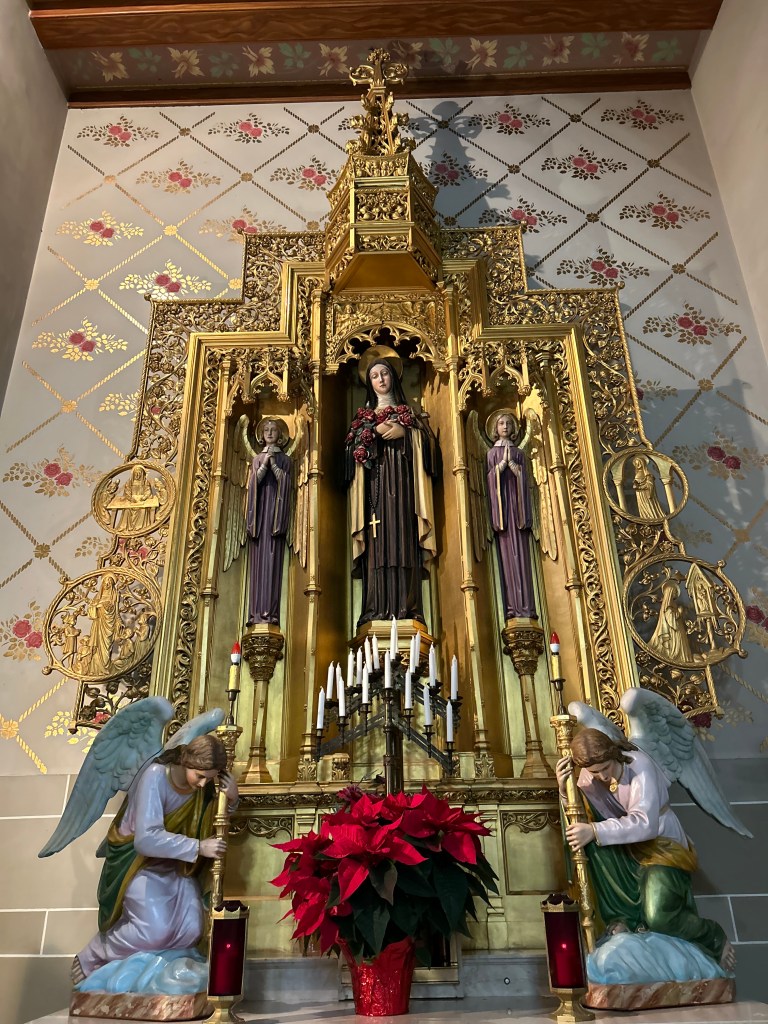
So this image that I have here for you is from St. Florian in Hamtramck, Michigan. And you can see that she’s holding a bouquet of roses. She also is associated with roses because after she died, she said that she would spend her heaven, raining roses down on people.
She suffered from tuberculosis and died at the age of 24.
She didn’t suffer very long, I think like a year before she started to cough up blood, and they all knew what that meant. At first they thought, ‘oh, maybe you’re just coughing too hard and you’re straining your throat’. But it continued to get worse. And one morning she woke up and her whole handkerchief was covered in blood and she knew that her time was near.
And she was happy about it. She couldn’t wait to be in heaven with God. And that just speaks to her innocence, and I think she was able to find hope, even in the most dismal situation. She was only at the convent for nine years before she passed away, and when she was sick, her superior mother recommended that she composed her spiritual autobiography Story of a Soul.
And it has continued to be one of the most widely read memoirs, spiritual memoirs of all time. So you can see here she’s sleeping or you know, reclined in her sick bed. They would often bring her bed out into the garden so she could get the fresh air and everything, and she’s holding her crucifix and in a lot of her icons she’s still holding that crucifix.
And if you visit the convent today, they have so many archives of her there, and they have that crucifix on file or on display. You can go to their website too and you can read letter after letter of her in her archives. You can read, little things she said, plays that she wrote, poems that she wrote.
So, she was very creative and she allowed God to speak through her creativity. So, this other picture is her after she passed away, her sister actually took that photo of her. Her sister, it seemed, was a big photographer in the convent, like her actual sister, I mean, was always taking pictures of everyone in the convent. She was a great photographer too. I mean, the way that she would pose everybody, and I don’t know if they did it themselves or she was telling them what to do, but she was pretty good. So you can see all of those photos in the archives at the convent’s website.
She said in her memoirs, “I want to spend my heaven doing good on earth”, and “after my death I will send a reign of roses”. And so, that’s why she’s associated with roses. And here’s another example of an icon of hers. So the phrase she’s most known for is “try to do every little thing with great love”, which is a really good little phrase or mantra to keep in your mind every day, to do every little thing with great love. This is called her little way, the little way of St. Therese of Lisieux. So everything associated with her is little or beautiful or innocent.
That’s how I like to think of her, but just had tremendous strength and stamina and just spunk, right? So I admire her for that. I encourage you to get her me memoir if you can, or if you’re interested. You can purchase it at any bookshop. They can order it for you. Amazon has it or Barnes and Noble or any of your independent bookshops, which I encourage that first.
Alright, so to talk about this meditation that she had, she viewed the holy face of Jesus as representing his unending love and mercy for us. So, it became part of her devotions. And you can see, I just wanted to share this with you because you can see the Shroud of Turin here. This face here is from the Shroud of Turin. They did do carbon dating on the shroud, and they assume that maybe the testing they did was from when it was repaired in the 1600s, 1500s, or 1400s, something like that. But what’s funny about it is that they think that when Jesus died, if they could make a theory about why this face was imprinted and the whole body was imprinted on the shroud was because when Jesus died, he gave out so much energy that it created this image.
Every wound on his body is present, and you can even see this might be blood dripping from the crown of thorns. Every wound is apparent in this shroud and that the wounds would’ve been made by the Roman whips that they used with the barb ends and everything. So there’s compelling evidence that says that it is the actual shroud of Christ.
On this side here we have the veil of Veronica, or Veronica’s veil. It’s not that it was named after a woman named Veronica that actually wiped the face of Christ. It’s named that because Veronica means ‘true icon’. But you can see that these charms that I gave out with the presentation, are taken from the shroud of Turin because it’s probably a little bit more visible. So they were able to depict what it looked like.
So what does it mean to be a mystic? I wanted to explain this because this is a common misconception, I think. I wanted to explain, and this is from my own brain. So take it with a grain of salt.
Father Richard Rohr calls mysticism “experiential religion”. Mystics see God in every moment. Some mystics translate the more profound God-moments through writing, art, and oratory to share them with others who might be blind to these moments with centering prayer or contemplative prayer, we open ourselves to seeing and understanding the world around us through the eyes of God. Seeing moments through the eyes of God is our birthright. It’s a practice that has to be nurtured and cultivated. And so if you are just looking around intentionally trying to see everything through the eyes of God. That is you moving toward the mystic part of you that is in you. It is your birthright. It just has to be nurtured and cultivated, and eventually you’ll start to see that everything has a deeper meaning to it.
It’s not that everything in the Bible is real or not real. We’re not Christians and priests and deacons to prove the Bible’s validity. That’s not what we’re doing. We could look at the Bible though as a miraculous collection that is for the most part, so wise and so true, written and transcribed by people with wisdom bestowed upon them, only because they sat quietly and observed the world around them.
The Bible is, is a place of stories. It’s where the human condition has been documented and handed down for centuries. It teaches us how to be human and stories like even Story of a Soul and other spiritual memoirs that people have published and passed down. These too are part of this collection.
It’s people that looked intentionally at the world around them, looked intentionally at their own place in it all, and tried to meditate on any sort of wisdom they could take from it that was eloquent and wise and filled with divine love.
Through the writing of the Bible, the stories and the poems and the visions and dreams, these wise observers were able to bestow their wisdom on other quiet observers who then meditated on these things and further interpreted these messages through art spoken word and through writing. Then as time went on, students and postulants of this quiet way, were able to take these lessons a little further.
And every Sunday we hear these ancient stories resurrected and made relevant to us as time unfolds and changes as a result of current events and migrating communities.
So what is the point of it all?
The point of it all, the point of church, the point of reading the Bible, the point of reading these spiritual stories, the point of looking at everything intentionally through the eyes of God or the eyes of love is to instill compassion, mercy, and love so we are kept safe and we learn to keep others safe because, really, this goes way back to our animal instinct. We want to be kept safe, but in order to keep this from becoming a toxic thing, we have to always remember to include “outsiders” and keep them safe as well. And to know also that even in our brokenness, we are loved by our communities.
Jesus said, “go and do likewise”, and by these stories we learn to love others in their brokenness so we can help them feel whole again. That’s the whole point. So we can help people, all people feel whole again.
Through our love, through our kindness, through our acceptance, our mercy, our compassion, it’s all to help people feel whole again. And in turn, it will help us feel whole again. So that’s the whole point as far as I see it.
Okay. Meditation time.
I’m just going to read this to you. Feel free to close your eyes and just take in the words this is great for Lent or Good Friday. This is a pretty much a good Friday meditation. Alright, so this is from the perspective of Jesus’s senses when he was on the cross.
Let us pray:
Lord, thank you for our eyes, our mouth, our nose, our skin, our ears, and all of our appendages and vital organs that keep us alive and keep us willing and keep us aware. Through these, we experience the sorrow and joy of others and ourselves. We become witnesses to the experience of life and all of God’s creation. What a gift!
May we live in this remembrance. Amen.
Meditation for the lips and mouth of Christ.
Your lips that were once kissed by loved ones. Your lips that once tasted the water from the well. Of a woman living on the margins once tasted once, kissed once with love. Now you taste blood and your own sweat, tears, and the dirt from the places on which you fell.
This is your last taste of earth. Breath passes in and out of your lips. The life in you is still active willing. Your mouth and lips are dry. Your throat is parched with thirst. You have a lump in your throat from your grief. Not for yourself, but for the people you love and you love them. All through our lips, we can choose to speak violence, love, or not at all
Meditation for the Lips/mouth of the Christ:
Your lips that were once kissed by loved ones, your lips that once tasted the water from the well of a woman living on the margins.
Once tasted.
Once kissed.
Once with Love…
Now you taste blood and your own sweat, tears, and the dirt from the places on which you fell. This is your last taste of earth.
Breath passes in and out of your lips, the life in you is still active, willing.
Your mouth and lips are dry. Your throat is parched with thirst. You have a lump in your throat from your grief, not for yourself, but for the people you love. And you love them all…
Through our lips we can choose to speak violence, love, or not at all.
You say:
“Forgive them, for they do not know what they are doing.”
“My God, my God, why have you forsaken me?”
You meant for yourself to be the last sacrifice, the last murder. “No more of this,” you said. You said, “It is finished.”
“It is finished.”
Meditation for the Nose of the Christ:
You smell the blood and the sweat dripping down and drying on your body. The wind is whipping around. You take in life-giving air. You breathe it in and out on us, standing below you as witnesses. You give us life this way…somehow. This is the mystery of faith. The air smells fresh up here, sometimes it’s mixed with the odor of the men on both sides of you, letting you know you’re still alive and in the middle of it all: the human experience.
Meditation for the Eyes of the Christ:
You saw the open sky. The crowd below. The witnesses. All eyes on you, many eyes on your eyes, all seeing but not all understanding. Some looked at you, saw your blood, and they felt nothing. You see their eyes with your eyes; you read their thoughts this way. Some are angry. Others, amused seeing you in this state, hanging there, helpless. Some see you as a thing to be watched as entertainment, killed like an animal, a scapegoat. You gave them something to talk about later, around their tables.
You look back at them with love. Teach us how to do this, Lord.
You see two people, one on the right, one on the left. They suffer as you suffer, yet they show two different sides of suffering: one reasoning, one bargaining, and what are you, Lord? You are submission, submission to sacrifice in the name of LOVE. Submission to the ‘good death’.
Through all of this woundedness, you see your mother, your women-followers, and your disciple, John, looking at you with compassion. They see all and have understanding. They are witnesses. You see them and know that they are the remnant. Witnesses of You, True witnesses because they see You and understand. They give you hope. You need them as much as they need you: the remnant.
Lord, infuse our hearts with love. Let us look and always see with your eyes. The eyes of compassion, the eyes of presence, the eyes of love.
Allow us to be a remnant of The Way.
Meditation of the Skin of Christ:
Your skin, burning, open wounds in the bright morning sun, closer to noon. A relief when the sun disappears. You feel the darkening sky cooling your skin. A relief. You know the time is nearing.
Meditation for the Ears of Christ:
Your ears hear the insults and accusations. You hear the gasps of shock and empathy as people witness your beating and when you fall. You hear the moaning and wailing of the women. You hear the beating of breasts.
Wounds poured on wounds:
“Speak, why don’t you defend yourself?”
“If you are the Messiah, tell us.”
“Save yourself and us.”
“Jesus…”
“Jesus…”
“Jesus…remember me…”
“Jesus…when you come into your kingdom…”
“remember me…”
In the Name of the Father, Son, and the Holy Spirit. Amen. ┼
So I hope you enjoyed that.
Again, if you want to send me your address, I’ll send you this and I’ll send you a little Holy Face charm. So you can always remember to see things from other people’s perspective and be aware of the world around you. Try to see God in every moment and through the eyes of love.
It’s hard sometimes, and that’s why I say it takes practice and the cultivation of that kind of seeing and understanding. So thank you so much for joining me today. I hope that you have a beautiful rest of your Lent and Easter. Thank you for joining me.
Bye-bye.


 BRIANNE TURCZYNSKI