

A SPECIAL EPISODE FOR LENT AND GOOD FRIDAY: St. Therese of Lisieux and The Holy Face Devotion – Loving the Imperfect
Welcome to Loving The Imperfect, A show for seekers of deeper contemplation. I’m Brianne Turczynski, a writer, a journalist, an educator who has listened to the stories of many people throughout the years, and I continue to read and broaden my understanding of the human condition through the stories of others. This season We introduce and discuss some modern-day prophets. People who have at least one thing in common, the prophetic voice.
The purpose of this season is to introduce listeners to some new artists and writers. We hope this selection will inspire you to read, write, and create, to be a force of love in the world. Hello everybody. Welcome back my name is Brianne Turczynski. I am the host of Loving the Imperfect, which is like an interspiritual, inclusive podcast but I’m also, an author and I wrote Detroit’s Lost Poletown, which is a story about, it’s a true story, about the Polish neighborhood that was, that was destroyed for the GM plant in Detroit in 1981.
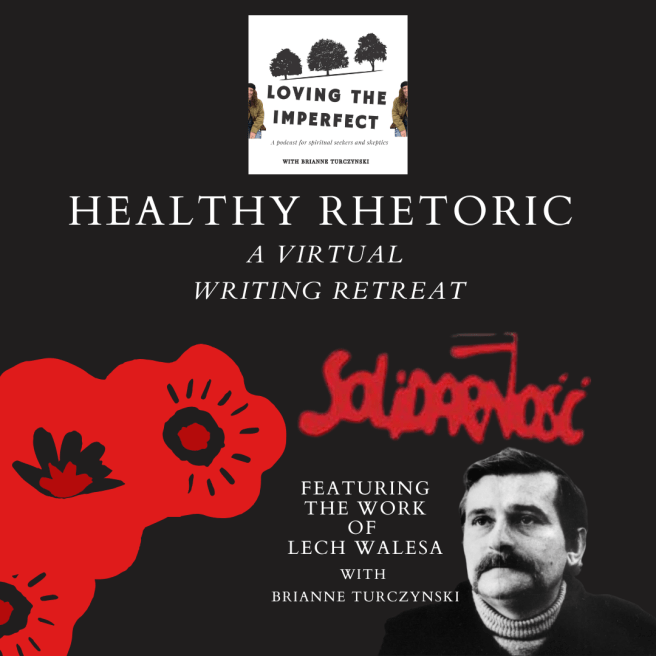
I love Polish history, I love Polish cinema, and today I’m incorporating. Healthy rhetoric, the idea of healthy rhetoric with Polish history. So these two things will come together and we will get to practice, some writing exercises, and at the end we should be able to pinpoint what we are being called to do at this moment in history.
I will go ahead and start with a couple meditation exercises first before we get into Polish history. So first of all, I joined a group called the Versed Community, and it is a group of poets and writers. It’s led by a former Harvard professor, and he gets different professors from all over the country from with different subjects, and they teach us classes.
And one day we had, well, for several days we had Professor Curry Kennedy, who is a rhetoric professor at Texas A&M. And I was very inspired by his teaching and the way he went about teaching it. And a lot of these writing exercises that I’m sharing with you today, those are his.
With his permission, I am using them today for this and I’m very honored that he gave me that permission. So, keep that in mind when we start in on this, but first we’re going to start with some meditation. The whole point of this is to realize that rhetoric is everywhere, not only in what we read and what we write, but it’s also in what we are hearing and what we’re reading and what we’re seeing in symbols all over.
You can think of like propaganda as a form of rhetoric and it’s very important for us to be able to listen to these things and pinpoint what is healthy rhetoric and what’s toxic? What is toxic rhetoric and how do we make space between ourselves and these things so that we don’t get manipulated or feeling even more anxious than we already do?
What is the truth? So, all right, so let’s begin. So first of all, rhetoric is the art of persuasion. It doesn’t have to be considered a form that is only through writing or speech. Sometimes people can be persuaded through art and images, like I said. “Rhetoric is the art of living well in language,” that’s according to Cicero and healthy rhetoric, marries wisdom and eloquence. “Rhetoric is for human flourishing before it is for individual gain.” And that’s from Aristotle. Cicero has a whole thing in his book On Invention, which I’ll share in a minute, about these people that are just sick of hearing eloquence because it has manipulated the people and has turned people against people.
So, they give up and they go into the woods. These wise men and women, and these are how I think we got our mystic mothers and fathers, our desert fathers and mothers who, in a Christian tradition, they went out into the desert and decided to start. Living a more contemplative life, but we need those people on the ground.
We need those people to practice their wisdom and eloquence, and so people can, they can share that wisdom with everyone to combat some of the toxic eloquence, the toxic rhetoric that we encounter on a day-to-day basis. This is a reading meditation. So, I’m going to read this passage to you by Cicero, and I’m going to ask you to just reflect on it as I’m reading it. And, you know, if you want, you can write down a couple words of what came up for you. What is it reminding you of, or what emotions does it spring up in you.
So in 90 BC Cicero wrote this in Rome as a like a 17-year-old. I think he was listening to his professor, and these are his notes from class (I think).
“For there was a time,” he writes, “when men wandered at large in the fields like animals and lived on wild, they did nothing by the guidance of reason but relied chiefly on physical strength. There was, as yet no ordered system of religious worship, nor of social duties. No one had seen legitimate marriage, nor had anyone looked upon children whom he knew to be his own, nor had they learned the advantages of an equitable code of law. And so, through their ignorance and error, blind and unreasoning passion satisfied itself by misuse of bodily strength, which is a very dangerous servant.
At this juncture, a man, great and wise I’m sure became aware of the power latent in man and the wide field offered by his mind for great achievements. If one could develop this power and improve it by instruction, men were scattered in fields and hidden in sylvan retreats. When he assembled and gathered them in accordance with a plan, he introduced them to every useful and honorable occupation. Though they cried out against it at first because of its novelty and then went through reason and eloquence, they had listened with greater attention. He transformed them from wild savages into a kind and gentle folk.
When therefore, he who regardless of wisdom, made eloquence. His only study was often equal in speaking and sometimes superior. It happened that in the opinion of many and his own conceit, he seemed a person worthy to govern the commonwealth.
Hence it was and not without reason, that when rash and audacious men were entrusted, with the helm of the government, great and miserable shipwrecks ensued by this means eloquence contracted so much hatred and envy that the most ingenious men made their retreat from this seditious and tumultuous way of life to some quiet study, as it were, out of a turbulent storm into a quiet haven.” -Cicero, On Invention
Okay, so if you want, you can pause this recording and just think about that for a minute. Okay, next slide. This is one of your writing exercises here.
1. Write a description of the quality of time you’re living in right now. This is a two part question, so we have part one, write a description of the quality of time you’re living in right now. (Professor Curry Kennedy)
Give that two minutes so you can pause the video and give yourself two minutes to reflect on that. Write that down.
Okay, next one. Part two:
2. Are the desires, plans and expectations. You have a good fit for the time you’re living in? (Professor Curry Kennedy)
Okay, now we’re going go back onto Bible. These are going to come from the Gospel of John, which is my favorite book. And I just happened to go through a whole thing where I was reading it very slowly, so I was only reading one section a day very, very slowly. And reflecting on that passage just sort of as a meditation every morning.
And as I’m going through this idea of healthy rhetoric, a few of these passages came up as good examples of something I could show you. So I want you to take these. Verses out of context completely. I want you to forget everything that you know about the Bible. I want you to forget the stories. I want you to forget that who Jesus is for a minute, okay?
And all of these, I want you to take out of context and see how damaging that can be to these passages themselves. So the point of this is to see how everything has to be in context. You have to keep everything in context. What are the motives behind somebody saying something? Why are they saying it? And who are they saying it to?
And who are they, right? These are very, very important things to keep in mind when we’re listening. And a good rhetorician, or a good writer, or a good artist is an excellent listener. And so, I’m going to read this passage, and I want you to think about what comes up for you. What emotions are coming up, just like we’ve done before:
“Whoever eats my flesh and drinks my blood, his eternal life, and I will raise them up on the last day for my flesh is real food and my blood is real drink. Whoever eats my flesh and drinks, my blood remains in me and I in them just as a living father sent me. And I live because of the father. So the one who feeds on me will live because of me. This is the bread that came down from heaven. Your ancestors ate manna and died, but whoever feeds on this bread will live forever.”
So taken out of context, that sounds pretty weird. And I can understand why some of the disciples said this is a hard teaching.
I have to go. You are weird. But the ones that had been following him said, who else are we going to go to? You have showed us what real life is like, what real life is, and we can’t leave you now. And they understood that there was more to this than just words. So they stuck around. But you can see that anyone coming to hearing Jesus for the first time would be really scared by this.
And, you know, if there was toxic. News like we have today, which I’m sure there was back then they would say, ‘Hey, there’s this guy that wants you to eat him.’ Something ridiculous to make everyone scared. So we have to be careful about putting things into context and trying to see both sides of everything.
That’s very important. Okay. All right. So here is the second verse. It’s not really a verse. It’s more like a dialogue between two people here. Now I want you to take this out of context again, we’re going to pretend that we don’t know who these people are and see what you can see, what’s coming up for you here, okay?
“Give glory to God by telling the truth they said. We know this man is a sinner. He replied whether he is a sinner or not. I don’t know. One thing I do know I was blind, but now I see. Then they asked him, what did he do to you? How did he open your eyes? He answered, I have told you already, and you did not listen.
Why do you want to hear it again? Do you want to become his disciples too? Then they hurled insults at him and said, you are this fellow’s disciple. We are disciples of Moses. We know that God spoke to Moses, but as for this fellow, we know we don’t even know where he comes from. The man answered. Now that is remarkable!
You don’t know where he comes from, yet He opened my eyes. We know that God does not listen to sinners. He listens to the godly person who does his will. Nobody has ever heard of opening the eyes of a man born blind. If this man were not from God, he could do nothing to this. They replied, you were steeped in sin at birth.”
How dare you lecture us, and they threw him out. So this is a man who is healed from his blindness by Jesus. Okay? We know this, but if you were hearing this for the first time, and even if you were that blind man, it took a lot of courage for him to speak truth to power and listen to these things that these men are saying to them.
These Pharisees are saying, “you are steeped in sin at birth. How dare you lecture us.” They are questioning his own reality. I know that we’ve all had people like this do this to us, and he knows what the truth is and he sticks to what he knows. And I think it’s very important, and I’m learning this myself just recently, trying to trust my own instincts because there are so many people that will always point to us and say, and make us question our own reality.
So we have to be true to ourselves by sticking up for what we believe in and not allowing these people to do this. Look, “give glory to God by telling the truth. We know this man is a sinner.” See, they’re already starting to manipulate him. We know this man is a sinner. We are the authority. So already they’re trying to get him to question himself, and then he says “whether he’s a sinner or not, I don’t know.”
So he just nullifies their accusations. Okay. He tells them the truth. “One thing I do know, I was blind, but now I see”—very simple. Then they ask him, “what did he do to you? How did he open your eyes?” Okay, so he already had told them this and they didn’t listen, and “why do you want to hear it again? Do you want to become his disciples too?”
“And then they hurled insults at him.” So this would be very difficult. And we have experienced this before, I’m sure. It just, it shows us how these people who throughout scripture have spoken truth to power are showing us how to do this. So these are the stories to pay attention to if you need a little encouragement, okay, they’re all over.
In fact, I think that the first people to speak truth to power in the whole Bible was in Exodus. The midwives who refused to kill the newborn boys, the Hebrew boys and Pharaoh had questioned them, and they lied to him and that’s how they got out of it. They just straight up lied. Sometimes you might have to do that, sometimes be a little bit clever. I don’t know. I don’t know the moral of that situation, but in this case, he told exactly the truth. He did what they told him. He told the truth, and the truth is always the best. So, all right, so this is something to reflect on here.
Let’s go to the next one. Okay. So I want you to take this out of context too. We know who says it, but forget that. Forget that.
“Why wasn’t this perfume sold and the money given to the poor, it was worth a year’s wages.”
Reading this, it sounds like Jesus would’ve said this, right? Hmm. It sounds like somebody who said this would be a good person.
They want to, you know, give money to the poor. That’s nice, but, when you put this back into context, you know exactly what’s happening and you know that Judas is kind of shady and we know that Mary had just, or a woman had poured expensive perfume all over Jesus’s feet, and we know why she did this.
But taken out of context, this looks pretty nice: why wasn’t this perfume sold and the money given to the poor, that sounds like the voice of a good person, right? But put it back into context and it’s the voice of evil. So that is why context is very, very important. And it’s important to look at these things.
So even when you’re reading scripture or you’re reading the newspaper, put stuff back into context and see what the truth is. Here’s another writing exercise.
3. Write down a quote you’ve heard that stuck with you. It can be something said by a relative or something from a book or film or whatever. (Professor Curry Kennedy)
What makes this quote significant for your life? What does it mean to you? All right, so take a couple minutes and do that, right? You can pause the video.
All right, next one:
4. What word moment was significant in your life? How did it change your life or define you? (Professor Curry Kennedy)
But we’re going to go back out to World War ii, the beginning of World War II. Now, this is a little bit of a history lesson, so if you don’t like history, go ahead and fast forward through all this. But this is important because as a historian, okay, I got my bachelor’s in history. Looking at history from a bird’s eye view, after everything has occurred, you can start to see patterns throughout history, and this too, to me, is rhetoric. You can use that to persuade others to make better choices, and so we’re going to look at the patterns of how World War II began. I want you to be aware of what’s happening in your body and in your mind and in your spirit as you’re hearing all these events.
World War II begins. Hitler basically thinks Poland is a made up country, that was created as a result of the Treaty of Versailles. So, there are a lot of other little things that happened before World War II actually began. But for the sake of this conversation, we’re going to say that it started in Poland.
Okay. So how it began was this.
Hitler wanted parts of Czechoslovakia. There were certain German communities that lived in Czechoslovakia around the border, and he wanted these communities to be absorbed into Germany, because there’s a German population there. In addition, all these little communities had these resources to create a big military, or at least, provide for him the resources he needed for a military.
And, so he wanted these parts of Czechoslovakia and maybe he was even talking about starting a war again or invading Czechoslovakia. So Italy, Britain, and France decided to appease his need, his want for this land, and they gave him what he wanted.
So by appeasing Hitler, by appeasing a man who really was power hungry and totally delusional, if you ask me, they made him hungrier for more. Meanwhile, the Soviet Union is trying to spread its communist ideals, and it wants to invade Poland from the east. The Soviet Union approaches Germany and says, ‘Hey, we’re thinking of invading Poland. Why don’t we create a piece between us since you’re on the other side of Poland, so that we don’t aid each other’s enemies and we don’t ally ourselves with each other’s enemies.’
So Germany agrees to this. They make a German Soviet pact of like peace kind of, and first Germany invades Poland and I think like couple days, couple weeks later, like 17 days or something, or 10 days. Soviet Union invades Poland. So Germany coming from the West Soviet Union coming from the east and they divide Poland up like this.
So that’s what it looked like. And they create what they call two spheres of influence within Poland. And this is in 1938, then in 1941, Hitler decides to invade the Soviet Union, and I wish I had a better map or a map of Russia right now, but if you look at a map of Russia, you can see all the major cities are kind of on that end of Russia.
And so that’s what Hitler was going for. And it ended up being, it was called Operation Barbarossa. And it ended up being the most expensive of offensive in military history. Uh, there were 8 million casualties, and it looked for a moment that Hitler was winning, and then it took a little longer than he thought, and they got into the Russian winter.
He should have learned something from Napoleon. I don’t know. So anyways, he, he thought that Germany was very overly confident, and they thought they would win the war in a couple of years. But after a while, they ended up having to take land just to get resources.
So this became more of a war of attrition rather than a very, very quick war. Operation Barbarossa basically crumbled the German confidence that they had at first when they first started. And that was pretty much the nail in the coffin for Germany for World War II success. They were not going to be successful as we see later.
So World War II ends—this is very quick, right? World War II ends and the Soviets push into Poland. Now they’ve taken over all of Poland and East Germany, and they use those areas as satellite states for communist ideals. So, under communism in Poland, the people were dealing with suppression of opposition to the regime.
Of course, this typical things, film, newspapers, art, education, television, and books were monitored and banned if they did not adhere to the censorship laws. And it eliminated checks and balances within the government and institutions and Control over economic activity was enforced. So, they controlled every little thing. If you wanted to get a car, you had to apply for one. If you wanted an apartment, you had to apply for one. If you needed a bigger home, you had to apply for one.
And we have propaganda all over the place to keep the regime in the forefront of everyone’s mind.
So when a regime takes over a country, the first thing to go is freedom of speech, newspapers, and television, and film.
All of that stuff is starting to be censored. And we’re seeing that even in the United States. I mean, I think every country probably sees a little bit of this, but the more conservative a government. The more we see it. We see right now, like Texas A&M for example, just had a professor let go because of what she was teaching in the classroom.
And then another professor, his whole syllabus had to be reworked because he was not allowed to teach Plato’s certain things from Plato’s Symposium. So we see it in this country. It’s something to keep an eye on. Because it’s dangerous. And then with film and newspapers. So when we think of these censorship boards, we think of these men or women in these gray rooms, smoking cigarettes and just crossing out scripts after script. That’s not really how it was. The censorship board for film, for example, they were film people. They loved film, they wanted to see these movies get made. Uh, but because these films were funded by the government, they had to be careful.
They wanted the film to be made so they would help the director rework anything that seemed like it might upset the government, might upset the regime. So that’s how the censorship board would really work. It would be more like a guide into communist ideals, if that makes sense.
One of my favorite directors is Andrzej Wajda, who was directing all through the communist era in Poland and beyond, and his father was one of the 22,000 Polish officers and intellectuals that were kidnapped and taken to the Kain Forest where they were massacred, one by one. So, 22,000 soldiers. 22,000 bullets. It wasn’t like a mass killing, like the Germans are known for gassing, it wasn’t like that. It was individual.
And then they were thrown into a mass grave. So in 1941, the Germans discovered this mass grave. And for years, the Polish citizens did not know what had happened to their fathers, their grandfathers, their sons, their brothers; they had just disappeared without any word. And so, when the Germans dug up this mass grave, they started to identify these men.
The Polish people had a sense that the Soviets had done it, but they weren’t allowed to talk about it. They weren’t allowed to investigate it. It was just zip it. And the Soviets blamed the Nazis, and the Nazis blamed the Soviets. And it went on and on and on for years. But the Soviets had done it.
And the all the Polish people knew, but they weren’t allowed to talk about it. So Andrzej Wajda’s father was one of those men that were kidnapped and taken and killed. And he desperately wanted to make a film about this story because that was sort of his expertise, was the stuff going on during World War II and beyond.
So he wasn’t allowed to though. So in 1989, finally he was able to say something, and he ended up making a film in, I think in 2010 or 2007, something like that. But it’s called Katyn and it’s really good, really, really sad, but very good. So I highly recommend any of his films. Ashes and Diamonds is a very, I love that film. Very, very artistically done and shot. And Man of Marble is also very good. I just love his films. So I wanted to introduce you to him if you haven’t heard of him.
This is the memorial in Russia. It is in Russia, if you noticed. So, it’s something that can’t really be visited by anyone who lacks the courage to go into Russia, which is a lot of people, I imagine.
The Polish president after Lech Wałesa, was going to go pay his respects to this memorial in the plane. He also had Lech Wałesa’s biographical translator for his biography in the plane, and the plane exploded in the sky over Russia. To this day people think/know that the Russians had done this on purpose, knowing exactly who was in that plane.
So, but it, you know, that would’ve started a war years ago, and they just kind of said, okay, we don’t want to mess with you. We’ll just say that it exploded. But I’m sure there’s a lot of anger still about that particular incident. All right, so the years go by, the Polish government or the Communist government is raining over Poland.
In 1970, the Polish government increases food prices right before Christmas. As a result, the workers from the Lenin Shipyard and Gdansk. Issued a strike against the government and insisted that trade unions be established to ensure better pay. The secretary of the United Polish Workers Party, which was the Communist Party at the time, ordered that the strike should be crushed by force, and 75 workers were killed.
But the government replaced its leader with someone more sympathetic to the working class. And, but this was the first nail in the coffin for Communist Poland. They had a strike happen. The people actually rose up against the government to voice their angst, and as a result, 75 people were killed. So Lech Wałesa would go on to say, the minute the government uses violence against its citizens, it’s finished.
So this was the first nail in the coffin for Communist Poland. And, but the communist government appeased the people just a little bit by issuing that a new leader of the United Polish Workers Party be put into place. Someone more sympathetic to the working class. But as you will see, this didn’t quite work out the way the government was hoping.
The second nail in the coffin was when Pope John Paul II was elected. He was a Polish Pope. So now the whole world is looking at Poland. The whole world is saying, what is Poland? What is this country? And the communist government. Is shocked by the outpouring of welcome for this man. They thought that people weren’t that religious, even though they had left the churches intact. The Catholic churches, they have, they had left them. They had their own autonomy, but they didn’t think, they thought they were kind of eking religion out of the people after all this time because the government is the thing.
And , but no, the truth came out with the election of this pope, and it was like a miracle because it happened right when Poland needed it most right after that strike had happened. And right when Solidarity is starting to be formed and then we have the Pope being elected and now the whole world is looking at Poland and they’re curious about Poland.
Now we have a world leader. I mean, the Pope is a world leader. The Pope has influence over world leaders. The Pope can do things that other people just can’t sometimes. So this is a new power that the Polish people had all of a sudden. And so he is elected. And of course, Lech Wałesa, too, sees this as a miracle, and it is.
He sees this as tremendous hope for Solidarity and what they wish for Poland for the future. Okay, so in 1980, after more instability, the government issued another increase on food. The workers went on strike again following the firing of one of their coworkers’ months before she was supposed to be.
Supposed to retire. They took over the shipyard demanding the government give in to their demands. They signed the August agreement in 1980 and that established Solidarity as a legal organization, the first legal organization outside of the communist government in Poland and its membership quickly rose to 10 million people.
And with these numbers, the government could see it was losing its power. So can you imagine with 10 million people the government is actually seeing with its eyes what these people actually thought of the government, what people actually thought of their system this whole time. It’s being revealed to them one after the other, and they’re losing their confidence.
What does a regime do when it’s losing its confidence in itself and in its own power? It establishes Martial Law. And so, in 1981, Solidarity is banned after Martial Law was declared and in 1983, after his imprisonment, Wałesa is awarded the Nobel Peace Prize, which brings more attention to Solidarity’s struggle.
So the government declares that martial law, which makes it very dangerous now, like Vale’s life is in danger. He was put in prison, and they put him in this house and they feed him beautiful, wonderful food every night. And I’m sure this kind of scared him. I mean, can you imagine if you’re being imprisoned by people and they feed you very well. It’s kind of like, Ooh, what are they going to do to me? Why are they feeding me so well? So, I’m sure he was really scared. They imprisoned thousands of people, not only him, but thousands of other people. So, when a government is doing that, he knows that a government is finished.
And, but when he won the Nobel Peace Prize, again, more attention is put on Poland, more attention is put on Solidarity. And he, his life is sort of saved by that because now the government has to keep him safe, right? The government can’t hurt him, or there will be a price to pay throughout the world. So, he is able to continue to work.
He does a lot of meetings in secret. The meetings are held in the church. The Catholic churches have embraced Solidarity, and they are speaking to Solidarity’s ideals, and they are becoming now the satellites for Solidarity and peace and freedom in Poland. And now that they had a Polish Pope, they can go to the Pope and say, this is what’s happening. And then the Pope can help create dialogue with different world leaders to get something happening. So, this is how it all sort of started. Communism started to crumble with all of these little things. This is a dangerous time though because of martial law being declared. So the people at this time who established themselves as a nuisance started to mysteriously disappear.
And like in 1984 when Father Jerzy Popiełuszko was kidnapped and murdered by the Polish Security Service for his association with Solidarity and his sermons and messages that often spoke of freedom and anti-regime, he knew that the authorities wanted to eliminate him, yet he kept speaking out against them.
So these were very dangerous times, and these were very dangerous people. But it just shows how much the church was a supporter in this, even risking their own lives for this. And so now Father Jerzy Popiełuszkois a considered a saint in the Catholic church, and he’s very famous in Poland, I would imagine. They have statues of him and memorials and all sorts of things.
The church remained like a satellite for peace and freedom and Solidarity. And that’s what’s so beautiful is I’ve seen this many times throughout my studies of history and in my book, Detroit’s Lost Poletown. Even in that story, the church was a safe haven for the movement, to save the neighborhood of Poletown and the church in Poland.
The churches in Poland were the same. They were that safe haven for Solidarity. Many secret meetings were, were took place in Catholic churches for Solidarity and the churches, worked with them to make sure that everything was very secret so that they could do the good work that they needed to do.
And I think that’s very beautiful that that has existed throughout all time. Churches have continued to be a safe haven for people, and we have to remember that, you know, because we can get stuck on the little details of how the church is this, or the church is that. But if you look at all time, the church has continued to be a safe haven.
And I think that we need to continue, the church needs to continue to be a safe haven for all people. And when it’s not, then it’s not doing its work. There were Polish churches, a couple Polish churches that were not into this. They were like, ‘no, we’re with the government. We’re working with the government.’
So don’t even think about knocking on our door. So you’re going to always have those two different opinions, but the church should always be a safe haven. And if it’s not, it’s not doing its work.
So in addition to being a satellite for Solidarity movement, the churches also put pressure on the communists to start a dialogue with Solidarity.
In 1989, after holding several roundtable talks, an election took place and Solidarity won and communism in Poland ended. So because of these dialogues that were able to happen, the church was an initiator in all this. They were able to hold a free election and Solidarity won. And so that was great. Wałesa became president.
He said this last year when he appeared at Pennsylvania State University. He still tours around and gives us messages, and I think we do need to listen to him. He says, “We need to put more strength, more power into the propaganda fight. He said, this is the biggest opportunity to bring order never in the history of the world have countries been so united against Russia.
Let’s take advantage of it.” He says, “we need to help Russia change its political system. The head of the state of Russia or China should not have more than two five-year terms. Nobody will build this sort of banditry, assuming that they wouldn’t have more than two five-year terms. The world is much more prepared today to fight these systems, and almost the entire world is against Russia. We have an opportunity to make order in Russia, but not in a forceful way. Under the leadership of the United States, we should lead a political fight, and the Russian people will be happy if we help them do that.”
So he says that the Russians have never had a democracy. So for them to think about, ‘oh, you know, remember the days when we had democracy and things were good?’ They can’t do that. They can’t look on past generations and see how things used to be. It has always been like this. So, that’s where they’re sort of like blind to what it could be. Alexi Navalny was killed in a Russian prison, but he was an activist trying to educate the Russian people and trying to get out there and say, hey, this is wrong. This is what’s happening in our government. And he was poisoned and then put in prison for that. But if there was one, there’s got to be more of those kinds of people in Russia, but they’re just being very quiet and they’re underground right now. And so, they’re there.
But how do we give them the confidence to move? How do we give them the confidence to move forward? And if you want to read some really moving posts, go onto Instagram if it’s still there. It might have been removed by now but go onto Instagram and visit Alexi Navalny Instagram page. I think there’s several of them, but he was, for a while.
I don’t know how he got these out there, but they were his like journal entries of how it was for him in prison and oh, he is just the best writer and if anybody could compile these things and put them in a book, that would be amazing because it’s just so beautiful the way he writes. Heartbreaking and beautiful.
So I would recommend that you, you go find his prison notes there because just amazing, he was an amazing person. I’m very sad that he’s gone. He was a hope. There’s more though, I’m sure right now. And we need to. Somehow give them the confidence to move forward. But maybe anyways, so he said during his speech, I went to go see him in Detroit.
That’s me. I look very happy, in Detroit, I went to go see him and he said that the average lifespan of a Russian soldier right now is like three days or something crazy, or five days because the leadership in Russia has no respect for human life. So Putin is using all he can to win, to do what he needs to do in Ukraine to get what he needs to get.
And it’s important for us, if we learned anything about appeasing Germany before World War II broke out, we need to not appease Putin. I know that some people have said we need to give him what he wants, and so the fighting will stop, and we can save lives and all this. But it’s, I think it’s important to fight the fight to keep fighting and keep pushing them and keep making him exhaust his resources, to eventually give up.
And I think that it’s important to not give in to tyranny and that’s it. So how to fight tyranny. Vale told us a couple of these things in his tour of Canada and the United States; he said that the government should have transparency. So, the government and institutions and corporations should all have transparency within their government, with their finances, with why they’re doing certain things, their different motives.
Everything should be transparent so that you are always telling the truth and people can follow you, follow your little breadcrumbs to see why you’re doing certain things. They wouldn’t have to do that if you just told them exactly why you’re doing something and when and how. So, transparency is key. He also says that it’s important to hold small group meetings to check in on people and get a sense of their needs and their wants.
And so, that’s very important. Small group, small group meetings. And he, he always did this throughout the eighties. With Solidarity. He did it as he when he was president, and it really helped him get a sense and a feel of what people wanted so that you don’t have a mob of people trying to force what they want because you haven’t listened to them.
What happens on a micro level when you’re not listening to someone and you haven’t listened and you don’t listen and you don’t listen, they finally start to get angry. They get aggressive, they start to push back in ways that are very, can be violent sometimes. That’s why small group meetings are important.
And he said that elected officials should be elected to two terms of five years each. In a 2007 interview with the Red Cross Review, he said,
“The United States leads the world economically and militarily, but it no longer does so morally. This is partly due to the fact that it has occasionally resorted to immoral methods to fight the phenomenon of international terrorism. It says, we have the money, we have the means.
We will fix the problem ourselves. But how much will this cost in h an terms? You have to prove your high moral standing by deeds, not words. This is, this also applies to detention. I say it with all due respect for the reasonable concerns for the United States, and as a friend of the Americans who are facing serious threats from terrorist organizations.
Terrorism, as we are witnessing it today, is a leftover of the two-block confrontation, both superpowers trained and equipped various groups and individuals and even entire nations to fight the enemy. When the Soviet Union collapsed, these people and groups supported by the former regime suddenly found themselves in a vacuum.
Now they are engaging in their own private wars. Since no considerable concern has been shown for these people over a significant period of time, we have not assisted them in their development. We have not supported them in their education, nor have we helped the finance their transition. Many of them now resort to violence.
In many ways, we demand. They open their societies, their economies, and adopt our values, but at the same time, we close our borders to them and we close our economies to their products. We have to find new ways to deal with this unsatisfactory situation. I see a great responsibility for Europe and its governments to cooperate constructively with America in this task and to work out modes of actions that are sustainable and accept acceptable on both sides of the Atlantic as well as worldwide.” -Lech Wałesa
Okay. Sounds familiar, doesn’t it? Even though this was 2007, but it sounds very familiar, like nothing has changed at all. Okay. So he also says,
“When I recall my own path of life, I cannot but speak of the violence, hatred and lies. A lesson drawn from such experiences, however, was that we can effectively oppose violence only if we ourselves do not resort to it.” -Lech Wałesa
If we’re going to oppose violence, we can’t resort to it ourselves. This also goes to what we are feeling in the heart. Now, the reason we have not, we feel like maybe we’re not winning, like maybe evil is triumphing over good. I think it’s because, you know, we have people protesting, we have people out there angry.
We have No King’s Day. We have people what happened in Venezuela, which is great, but how many of these people protesting actually love Donald Trump? Or actually love Putin. How many of them? How many of them walk in those protests with such hatred in their hearts toward these men that you know, they’re just spewing hatred instead of peace? And so that’s why a lot of these things feel unsuccessful because we’re going at it in the wrong way. We need to approach it with love and compassion. And as hard as that is, we have to continue to practice loving our enemies. That’s what real Christians do.
We protest with total love. I see these monks marching to Washington right now. I’m sure that they have compassion on their minds that is part of their practice. When China took over Tibet and kidnapped all those monks, that was part of their practice while they were in prison for up to 10 years, some of them, to continue to love, continue to have compassion towards their captors, and it was hard and difficult as they’re starving to death and actually eating the dead prisoners who had died with them.
I can’t imagine the kind of compassion that would take what that would take. And it’s hard, and as I’m saying this to you, I know it’s difficult for me too, but it’s very important. That’s why it’s not feeling successful, even though maybe it is a little bit. But we have to do this with love if we’re going to do it, period.
Lech Wałesa’s Solidarity movement was a non-violent movement. They did not speak violently. They did not use violence. And you can see that in his speeches; how careful he is when he talks. He was friend[ly] with Gorbachev, he respected him, at least, but he knew that the man was lying. But he spoke to him like a like a person and he enjoyed his company, so we have to remember that these are human beings.
So another, writing exercise we’ll do is
5. I want you to think about all the people who have loved you into being and write about how it felt to be with these people. What did they do or say that made, you know, it was a loving relationship. (Mirabai Starr, Wild Mercy)
So give yourself like five minutes to think about that and write a reflection response. All right. Now I want you to look back on all you have written on the writing reflections that we’ve done. Not the meditations necessarily, but the actual writing exercises that we’ve done.
And I want you to create a theme that brings all of these together. So one word maybe, and then I want you to create a new sentence about yourself using these themes from each writing exercise. So if we go back through these exercises, here’s one. So the one that says, write a description of the quality of time you’re living in right now.
So that’s one exercise. Are the desires, plans, and expectations you have a good fit for the time you’re living in. So give whatever you’ve written with that response, some sort of theme, what do you see in that about yourself?
And write down a quote you’ve heard that stuck with you. Whatever this quote is, what does that quote represent? What does it mean to you? Why do you keep remembering it? What is, what is its significance in your life? What’s the theme of that? Is it fellowship? Is it togetherness? Is it love? Is it family?
What is the theme? And then what word moment was significant in your life? How did it change your life or define you? So same. What is, what does this word mean? What does it represent?
Think about the people who have loved you into being and write about how it felt to be with these people. What did they do or say that made, you know, it was a loving relationship. So what did they do? Did they listen to you? Did they share food with you? Did they share their home with you? Did they make you feel very comfortable and safe. What is it? What is the one thing that made you know you were in a loving relationship as opposed to a toxic one?
So when you think back on all those, and you have all those little themes that you’ve written in response, create a new sentence about yourself using these themes from each writing exercise.
So, for example, when I went back on my own, my first response was about bringing others to experience, community and love.
And my second response was a quote from E.M. Forster’s novel, A Room with A View: “Anyone can find a place, but the finding of people is a gift from God.” So that is, again, about community.
And then, a special word moment would be like the word mystic.
When I learned what that meant and what that was the turning point of my life. I really felt that was who I was somehow, that knowing what that word meant would really help define who I was and who I should try to find, and what community I needed to be in. So that was a very important word moment for me.
And then number four was: Think about the people who have loved you into being when the love is unconditional and genuine. This is how I know that it’s a true and lasting relationship.
So when I combined all of those sentences in this last writing exercise, my sentence that I created was:
“I am a mystic who wants to bring others into a loving community and help others find their people in a community where they will know a deeper and genuine love.”
I pulled out the different themes from all of those writing exercises, and I used them to create this sentence. I hope that makes sense, but it really helped me. And I hope it can help you figure out in all the mess and the noise and the nonsense that’s happening in the world right now, it can help you figure out what are you actually called to do right now?
And find out who is it that you need to find or be? So I hope this was all helpful. Thank you so much for joining me today and, maybe I’ll continue to do stuff like this. If this was fruitful for you, please don’t hesitate to contact me or write a comment. My website is www.BrianneTurczynski or www.lovingtheimperfect.com . My website is filled with all sorts of different posts I’ve done and different work and where I’ve been published and things like that. So, I hope that you will return if this is your first time with me and you can find me on Spotify and Apple Podcasts as well as YouTube. So, thank you so much and I hope that this was helpful and I’ll see you next time.
Bye-bye.


 BRIANNE TURCZYNSKI